
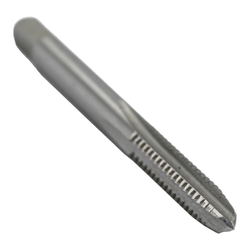
Tin-Coated Hand Taps
TiN-Coated Hand Taps for Improved Wear Resistance
Shop titanium nitride (TiN) coated hand taps for cutting internal threads in metal. TiN is a hard, gold-colored coating applied to cutting tools to improve surface wear resistance and reduce friction during threading operations.
TiN-coated taps are an excellent option for machine shops, metal fabrication, maintenance, and repeated threading applications where longer tool life and consistent cutting performance are important. Choose from plug hand taps and spiral point taps to match your threading requirements.
What Is a TiN-Coated Hand Tap?
TiN stands for titanium nitride, a thin, hard coating applied to the surface of a cutting tool. The coating provides a wear-resistant layer that can help reduce friction and protect cutting edges during appropriate threading operations.
TiN coating does not replace the underlying tool material. The tap's substrate, cutting geometry, and coating work together to determine its performance. Always verify the material and specifications of the individual tap.
Improved Wear Resistance
The hard TiN surface can help reduce abrasive wear on cutting edges, particularly during repeated threading operations.
Reduced Friction
TiN coating can reduce friction between the tap and workpiece, supporting smoother cutting under suitable operating conditions.
Potential for Longer Tool Life
Compared with an otherwise similar uncoated tap, a TiN-coated tap may provide longer service life in compatible materials and applications. Actual results depend on the workpiece, cutting conditions, lubrication, and tap design.
TiN-Coated Plug Taps vs. Spiral Point Taps
TiN-Coated Plug Hand Taps
Plug taps feature a moderate lead chamfer and are versatile for general-purpose internal threading. They can be used by hand or in suitable machine-tapping applications and are often selected for through holes or holes with adequate clearance for the chamfer.
TiN-Coated Spiral Point Taps
Spiral point taps, also called gun taps, are designed to direct chips forward during threading. They are especially useful for through-hole machine tapping, where chips can exit through the opposite side of the workpiece.
Which should you choose? Choose a plug tap for versatile general-purpose threading. Choose a spiral point tap when efficient chip evacuation through a through hole is a priority.
For additional threading tools, browse our Hand Taps or Spiral Pointed Taps categories.
TiN-Coated vs. Uncoated Taps
Uncoated Taps
Uncoated taps are a practical choice for many general-purpose threading applications. They can be particularly useful for occasional work or when the coating benefits do not justify the additional cost.
TiN-Coated Taps
TiN-coated taps provide an additional wear-resistant surface that can improve tool life in suitable applications. They may be especially beneficial for repeated tapping operations and materials where friction and cutting-edge wear are concerns.
TiN coating does not make every tap suitable for every metal. Choose the correct tap substrate, geometry, and cutting conditions for your workpiece material.
How to Choose the Correct TiN-Coated Tap
Identify the Thread Size
Determine the required nominal diameter and thread pitch or threads per inch (TPI). For inch threads, confirm the UNC, UNF, or other required thread specification.
Consider Through Holes vs. Blind Holes
Spiral point taps are generally preferred for through holes because they push chips forward. For blind holes, select a tap designed for the available hole depth and chip evacuation requirements.
Choose the Correct Tap Drill Size
Proper hole preparation helps reduce tapping torque and supports accurate thread formation. Use our Tap and Drill Chart or Special Tap and Drill Size Calculator to identify appropriate drill sizes.
Use Suitable Lubrication
Even with a low-friction coating, proper cutting fluid and chip management remain important. Follow the recommendations for the tap and workpiece material.
Frequently Asked Questions About TiN-Coated Hand Taps
What does TiN coating do on a tap?
Titanium nitride coating provides a hard, wear-resistant surface that can reduce friction and improve cutting-tool life in suitable threading applications.
Are TiN-coated taps better than uncoated taps?
They can provide better wear resistance and longer tool life in certain applications. However, the best choice depends on the material being tapped, frequency of use, tap design, and operating conditions.
What is the difference between a plug tap and a spiral point tap?
A plug tap is a versatile general-purpose threading tool with a moderate chamfer. A spiral point tap has geometry designed to push chips forward, making it particularly useful for through-hole tapping.
Can TiN-coated taps be used for machine tapping?
Yes, when the specific tap is designed for the operation. Spiral point taps are commonly used for machine tapping through holes, while plug taps may be used by hand or machine depending on their specifications.
Do TiN-coated taps still require cutting fluid?
Often, yes. The coating can reduce friction, but suitable cutting fluid may still be important for cooling, lubrication, chip management, and tool life.
Can TiN-coated taps be used in blind holes?
Some tap styles can be used in blind holes when there is sufficient clearance. Spiral point taps push chips forward and are generally better suited to through holes. Select the appropriate tap geometry for blind-hole applications.
Learn More About Taps and Thread Cutting
Watch our Drill America video to learn more about taps and threading tools. Explore our complete Taps selection for additional threading options.