
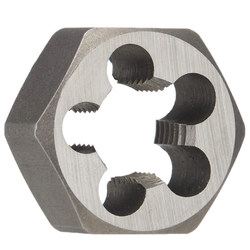
British Standard Hex Dies
-
 Carbon Steel, British Standard Fine Hex Dies
-
 Carbon Steel, British Standard Pipe Hex Dies
-
 Carbon Steel, British Standard Withwort Hex Dies
British Standard Hex Dies – BSW and BSF Thread Repair
Shop British Standard hex rethreading dies for cleaning, repairing, and restoring damaged external threads on British Standard bolts, studs, and threaded rods. Our Qualtech carbon steel hex dies are available in British Standard Whitworth (BSW) and British Standard Fine (BSF) thread sizes.
British Standard threads are commonly encountered on older British machinery, vintage automobiles, motorcycles, agricultural equipment, and industrial components. Selecting the correct thread standard is essential because British Standard threads are not necessarily interchangeable with American or metric threads.
Carbon steel hex dies are designed primarily for restoring existing threads that have become rusty, bruised, or slightly deformed. Their six-sided exterior allows them to be turned with a properly sized wrench or compatible holder, making them practical for maintenance and field repairs.
Choose between British Standard Whitworth and British Standard Fine dies below, then select the exact diameter and threads per inch required for your fastener.
British Standard Whitworth (BSW) vs. British Standard Fine (BSF) Hex Dies
BSW and BSF are two established British thread systems. Both use a 55-degree Whitworth thread form, but they have different standard thread pitches for many of the same nominal diameters.
British Standard Whitworth (BSW) Hex Dies
BSW is the traditional British Standard Whitworth thread system. It generally uses a coarser pitch than BSF at the same nominal diameter.
BSW threads are found on older British equipment, machinery, vehicles, and general-purpose fasteners manufactured to Whitworth standards.
Examples include 1/4"-20 BSW, 3/8"-16 BSW, 1/2"-12 BSW, and 3/4"-10 BSW.
British Standard Fine (BSF) Hex Dies
BSF uses a finer thread pitch than BSW for many corresponding nominal diameters. These threads are frequently encountered on older British automotive, motorcycle, machinery, and mechanical assemblies.
Examples include 1/4"-26 BSF, 3/8"-20 BSF, 1/2"-16 BSF, and 3/4"-12 BSF.
Always confirm whether the existing fastener uses BSW or BSF before selecting a die. The same nominal diameter can have different thread pitches depending on the standard.
What Makes British Standard Threads Different?
British Standard Whitworth-form threads have a different geometry from the Unified and ISO metric threads commonly used today.
55-Degree Thread Angle
BSW and BSF use a 55-degree thread angle with rounded thread crests and roots. Unified inch threads and ISO metric threads use a 60-degree thread angle.
Threads Per Inch
BSW and BSF sizes are normally identified by nominal diameter in inches and threads per inch (TPI). For example, 1/2"-12 BSW identifies a nominal 1/2" diameter with 12 threads per inch.
Different Pitch Combinations
BSW and BSF may use different pitches from American UNC and UNF fasteners of the same diameter. Even where the TPI matches, the thread geometry may differ.
Not the Same as British Pipe Threads
BSW and BSF are fastening thread systems. British Standard Pipe (BSP) threads are a separate family used for pipe and fitting connections. A BSW or BSF die should not be substituted for a BSP die.
BSW vs. BSF Thread Size Chart
The following reference chart compares common British Standard Whitworth and British Standard Fine thread pitches. These are standard thread specifications, not a complete inventory listing.
| Nominal Diameter | BSW Threads Per Inch | BSF Threads Per Inch |
|---|---|---|
| 1/4" | 20 | 26 |
| 5/16" | 18 | 22 |
| 3/8" | 16 | 20 |
| 7/16" | 14 | 18 |
| 1/2" | 12 | 16 |
| 9/16" | 12 | 16 |
| 5/8" | 11 | 14 |
| 3/4" | 10 | 12 |
| 7/8" | 9 | 11 |
| 1" | 8 | 10 |
Before ordering, verify the diameter, pitch, and thread form of the existing fastener. Refer to the individual product listings for available sizes.
British Standard vs. American UNC and UNF Threads
One of the most common mistakes when repairing British machinery is assuming that an American threading die will fit because the diameter and TPI appear identical.
BSW vs. UNC
Some BSW and UNC thread sizes share the same nominal diameter and TPI. For example, both 1/4"-20 BSW and 1/4"-20 UNC have 20 threads per inch.
However, BSW uses a 55-degree Whitworth thread form, while UNC uses a 60-degree Unified thread form. The two standards should not be treated as interchangeable for accurate thread repair.
BSF vs. UNF
British Standard Fine and Unified National Fine threads are different thread systems. Their standard pitches often differ even when the nominal diameter is the same.
For example, 1/4"-26 BSF has 26 threads per inch, while 1/4"-28 UNF has 28 threads per inch.
Why Matching the Thread Form Matters
Using a die with the wrong thread angle or pitch can alter the original thread geometry, reduce proper engagement, or damage the fastener. Always use the correct thread standard.
Common Applications for British Standard Hex Dies
Vintage British Automobiles
Restoring suitable BSW and BSF fasteners on older British vehicles and mechanical assemblies where original thread specifications must be preserved.
Classic British Motorcycles
Repairing British Standard threaded fasteners on compatible vintage motorcycles and restoration projects. Always verify the original thread system, as other British thread standards were also used.
Older Industrial Machinery
Cleaning damaged external threads on machinery, fixtures, and equipment originally manufactured to British Standard specifications.
Agricultural and Mechanical Equipment
Restoring existing British Standard bolts and studs on older agricultural equipment and mechanical components.
Restoration and Maintenance Workshops
Repairing original fasteners when replacing them with modern metric or Unified hardware would be inappropriate.
Why Choose Carbon Steel British Standard Hex Dies?
Carbon steel hex rethreading dies are particularly useful for restoring existing British Standard threads rather than cutting completely new threads in hard materials.
Designed for Thread Restoration
Carbon steel hex dies are suitable for removing minor burrs, rust, and deformation from existing external threads when the original profile remains intact.
Economical for Maintenance
Carbon steel dies provide a practical option for occasional repairs, equipment restoration, and maintaining less common thread standards.
Convenient Wrench Operation
The six-sided exterior allows the die to be turned with a properly sized wrench or compatible holder, making it useful for shop and field repairs.
Can Carbon Steel British Dies Cut New Threads?
They can cut new threads in suitable softer materials, but their primary application is rethreading. For cutting new threads in steel or more demanding materials, a suitable HSS threading die is generally preferred.
How to Repair British Standard Threads with a Hex Die
1. Identify the Thread Standard
Determine whether the fastener uses BSW, BSF, or another British thread system. Do not assume that all older British fasteners use the same standard.
2. Measure Diameter and TPI
Confirm the nominal diameter and threads per inch using the original specifications or suitable thread measurement tools.
3. Inspect the Existing Threads
Check for corrosion, burrs, and minor deformation. Replace fasteners that are cracked, severely stripped, or structurally compromised.
4. Clean and Lubricate
Remove loose dirt and corrosion. Apply suitable cutting fluid or lubricant where appropriate for the material and application.
5. Start the Die Squarely
Align the die carefully with the existing thread. Avoid forcing the tool or starting at an angle.
6. Turn Slowly
Use a properly fitting wrench or holder. Turn gradually and reverse slightly as appropriate to clear chips or debris.
7. Inspect the Repaired Thread
Remove the die, clean the fastener, and verify proper engagement with a suitable mating component or thread inspection tool.
Frequently Asked Questions About British Standard Hex Dies
What is a British Standard hex die?
It is a six-sided external threading die designed for a British thread standard, such as BSW or BSF, and used to cut or restore matching external threads.
What does BSW stand for?
BSW stands for British Standard Whitworth, a traditional British fastening thread system.
What does BSF stand for?
BSF stands for British Standard Fine, a British fastening thread system with finer pitches than BSW for many corresponding diameters.
What is the difference between BSW and BSF?
Both use the 55-degree Whitworth thread form, but they have different standard thread pitches for many nominal diameters.
What angle are Whitworth threads?
BSW and BSF use a 55-degree thread angle.
Are BSW and UNC threads the same?
No. Some sizes share the same diameter and TPI, but BSW uses a 55-degree thread form and UNC uses a 60-degree thread form.
Are BSF and UNF interchangeable?
No. BSF and UNF have different thread specifications and should not be substituted for one another.
What is a 1/4"-20 BSW die?
It is a die for a nominal 1/4" British Standard Whitworth thread with 20 threads per inch.
What is a 1/4"-26 BSF die?
It is a die for a nominal 1/4" British Standard Fine thread with 26 threads per inch.
Are British Standard threads measured in inches?
BSW and BSF nominal diameters are specified in inches, and their pitches are commonly expressed as threads per inch.
Can British Standard hex dies repair rusty threads?
Yes. Carbon steel hex dies are commonly used to clean light corrosion and repair minor damage to existing external threads.
Can I use a regular wrench with a British Standard hex die?
Yes. Use a properly sized wrench or compatible hex die holder that securely fits the die.
Do British Standard hex dies need a special die stock?
A dedicated round die stock is generally unnecessary because the hexagonal exterior can be driven using a suitable wrench or holder.
Can carbon steel British Standard dies cut new threads?
They can cut new threads in suitable softer materials, but are primarily intended for rethreading. HSS dies are generally preferred for new threads in steel.
Are British Standard threads still used?
They remain important for maintenance, restoration, and replacement parts on older British machinery, vehicles, and equipment.
Are British Standard threads the same as BSP?
No. BSW and BSF are fastening thread systems, while BSP is a separate family of pipe threads.
Can I use a metric die on a Whitworth bolt?
No. Metric and Whitworth threads use different standards and thread geometry.
How do I identify an unknown British thread?
Measure the diameter and TPI, then compare the results with British thread reference specifications. Confirm the thread form when similar Unified sizes exist.
Can I repair a completely stripped British Standard bolt?
No. A rethreading die cannot replace missing material or restore the strength of a severely stripped fastener.
What is the best die for restoring a vintage British bolt?
A correctly sized BSW or BSF carbon steel hex rethreading die is generally a practical choice when the original threads are only lightly damaged.
Related British Standard Dies and Threading Tools
For traditional Whitworth coarse threads, browse Carbon Steel British Standard Whitworth Hex Dies.
For finer British Standard threads, explore Carbon Steel British Standard Fine Hex Dies.
For American inch-based threads, visit our Fractional and Machine Screw Carbon Steel Hex Dies.
For metric threads, see our Metric Carbon Steel Hex Dies.
To compare additional die types, browse our Hex Rethreading Dies or complete Threading Dies selection.
Learn More About British Standard Hex Dies
Watch our threading die video for an overview of external threading tools and common die designs.
BSW and BSF Dies for Thread Restoration
British Standard hex dies are useful for restoring damaged external threads on older British machinery, vehicles, and equipment.
Correctly identifying BSW or BSF threads is essential because British Standard thread geometry differs from Unified and metric standards.
Browse our British Standard Whitworth and British Standard Fine hex dies to find the correct diameter and pitch for your application.