
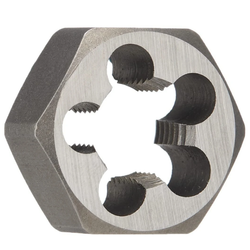
Carbon Steel Rethreading Hex Dies
Carbon Steel Hex Rethreading Dies – Repair Damaged Bolt and Stud Threads
Shop carbon steel hex rethreading dies for cleaning, repairing, and restoring damaged external threads on bolts, studs, threaded rods, and other fasteners. These six-sided threading dies are designed primarily for maintenance and repair applications where existing threads have become rusty, bruised, or slightly deformed.
Carbon steel hex dies are a practical and economical solution for everyday thread restoration. Their hexagonal exterior allows them to be turned using a properly sized wrench or compatible holder, making them convenient for shop maintenance, automotive repairs, industrial equipment service, and field applications.
Unlike dies primarily intended for cutting new threads, carbon steel rethreading dies are especially useful for following an existing thread profile and removing minor damage or debris. They can also cut new threads in suitable softer materials when the specific die is appropriate for that application.
Choose the correct thread diameter, pitch, and cutting direction from our selection of carbon steel hex dies.
What Are Carbon Steel Hex Rethreading Dies Used For?
Carbon steel hex rethreading dies are primarily used to restore existing external threads rather than create entirely new threads from unthreaded material.
When a correctly sized die is carefully turned over an existing thread, its cutting edges can remove small burrs, corrosion, or displaced material that prevents proper thread engagement.
Repairing Damaged Bolt Threads
Bolts can develop damaged threads from impacts, improper assembly, or everyday mechanical wear. A carbon steel hex die can help restore minor thread deformation when the fastener remains structurally sound.
Cleaning Rusty Threads
Corrosion can make it difficult to install or remove nuts. A rethreading die can clean light rust and debris from the existing thread profile.
Restoring Stud Threads
Studs installed in machinery, engines, and equipment can be difficult to replace. Hex dies are convenient for repairing accessible external threads while the stud remains installed.
Removing Burrs and Minor Deformation
Small burrs or raised areas can interfere with thread engagement. A correctly matched rethreading die can remove these imperfections and help restore smoother assembly.
Cleaning Paint and Contamination
Paint, dirt, and other debris can accumulate on exposed threads. A hex rethreading die can help clean the existing thread profile when brushing or other non-cutting methods are insufficient.
Why Choose Carbon Steel for Rethreading?
Carbon steel is a popular material for hex rethreading dies because it provides a practical balance of durability, cutting ability, and cost for routine thread repair.
Well Suited for Existing Threads
Most rethreading work involves removing relatively small amounts of material rather than cutting a complete new thread. Carbon steel dies are well suited to these maintenance applications.
Economical for Maintenance Departments
Carbon steel hex dies are generally more economical than comparable HSS dies, making them a sensible choice for maintenance shops and tool inventories.
Convenient for Occasional Repairs
When you need to repair a damaged bolt or stud occasionally, a carbon steel hex die can provide the necessary thread-restoration capability without requiring a more expensive cutting tool.
Can Carbon Steel Dies Cut New Threads?
Yes, in suitable softer materials. However, carbon steel hex dies are primarily intended for rethreading. For creating new threads in steel and other more demanding materials, a suitable HSS hex die or round adjustable threading die is generally preferred.
Advantages of the Hexagonal Die Design
The six-sided shape is one of the main reasons hex dies are so convenient for maintenance and repair.
Use with a Standard Wrench
A carbon steel hex die can be turned with a properly sized wrench or compatible hex die holder. This eliminates the need for a dedicated round die stock in many repair applications.
Convenient for Field Repairs
Hex dies are useful when repairing equipment outside a machine shop. A suitable wrench and the correctly sized die may be all that is needed for a basic rethreading operation.
Useful on Installed Studs
The compact hexagonal design can be convenient when working on accessible studs or threaded components that cannot easily be removed from equipment.
Simple to Keep in a Tool Kit
Individual hex dies are compact and easy to organize by thread size, making them useful additions to automotive, industrial, and general maintenance tool collections.
Understanding Carbon Steel Hex Die Sizes and Thread Pitches
Choosing the correct thread specification is essential. A die with the wrong diameter or pitch can damage an otherwise repairable fastener.
UNC – Unified National Coarse
UNC threads have a relatively coarse pitch and are commonly used on general-purpose fasteners.
For example, a 1/2"-13 UNC die is designed for a nominal 1/2" thread diameter with 13 threads per inch.
UNF – Unified National Fine
UNF threads have a finer pitch than UNC threads of the same diameter.
For example, a 1/2"-20 UNF die has 20 threads per inch and is not interchangeable with a 1/2"-13 UNC die.
UNS – Unified National Special
UNS identifies special Unified thread diameter and pitch combinations outside the common coarse and fine series. Always verify the exact specification before ordering.
Metric Threads
Metric thread sizes are expressed in millimeters. For example, M10 x 1.5 identifies a nominal 10 mm thread diameter with a 1.5 mm pitch.
Do not substitute an approximately equivalent inch die for a metric thread.
Right-Hand and Left-Hand Threads
Most conventional bolts have right-hand threads, which tighten clockwise. Left-hand threads tighten counterclockwise and require a matching left-hand die.
Always verify the cutting direction in the individual product specifications.
Common Carbon Steel Hex Die Thread Sizes
The following examples illustrate how nominal diameter and thread pitch are specified. Choose the exact size that matches your fastener.
| Example Die Size | Thread Series | Threads Per Inch | Thread Type |
|---|---|---|---|
| 1/4"-20 | UNC | 20 | Coarse |
| 1/4"-28 | UNF | 28 | Fine |
| 5/16"-18 | UNC | 18 | Coarse |
| 3/8"-16 | UNC | 16 | Coarse |
| 3/8"-24 | UNF | 24 | Fine |
| 1/2"-13 | UNC | 13 | Coarse |
| 1/2"-20 | UNF | 20 | Fine |
| 5/8"-11 | UNC | 11 | Coarse |
| 3/4"-10 | UNC | 10 | Coarse |
These are thread-size examples, not a complete inventory listing. Refer to the products displayed in this category for available sizes and cutting directions.
Common Applications for Carbon Steel Hex Rethreading Dies
Automotive Maintenance
Cleaning and restoring minor thread damage on suitable bolts, studs, and mechanical fasteners during vehicle repairs.
Industrial Machinery
Repairing external threads on equipment fasteners and threaded components during routine maintenance.
Agricultural Equipment
Restoring threads exposed to dirt, moisture, and corrosion on farm machinery and related equipment.
Construction Equipment
Cleaning damaged or corroded threads on compatible bolts, studs, and mounting hardware.
Mechanical Workshops
Restoring reusable fasteners and removing minor burrs or deformation from external threads.
General Maintenance and Field Service
Performing thread repairs on installed equipment when replacing a threaded component would be inconvenient or unnecessary.
How to Use a Carbon Steel Hex Rethreading Die
1. Identify the Thread Size
Determine the nominal thread diameter, pitch, thread standard, and cutting direction. Use a thread pitch gauge or known fastener specification when necessary.
2. Inspect the Existing Threads
Check for corrosion, burrs, and deformation. Confirm that the fastener is structurally sound and that the damage is minor enough to repair.
3. Remove Loose Rust and Debris
Clean the threaded area before starting. A wire brush or suitable cleaning method can remove loose material that would otherwise interfere with the die.
4. Apply Suitable Lubrication
Use an appropriate cutting fluid or lubricant when recommended for the workpiece material and application.
5. Start the Die Squarely
Align the die with the existing threads. Begin carefully to avoid cross-threading or removing unnecessary material.
6. Turn Slowly with a Properly Sized Wrench
Use a wrench or holder that securely fits the hex die. Turn gradually and allow the die to follow the original thread profile. Reverse slightly as appropriate to clear chips or debris.
7. Check the Finished Threads
Remove the die, clean the repaired area, and inspect the thread. Confirm proper engagement with a suitable mating fastener or thread inspection tool.
What Can a Carbon Steel Hex Die Repair?
Carbon steel hex rethreading dies work best when the original thread profile is still present and the damage is limited.
| Thread Condition | Can a Rethreading Die Help? |
|---|---|
| Light surface rust | Generally yes |
| Minor burrs | Generally yes |
| Paint or debris in threads | Often, when cleaning alone is insufficient |
| Slightly bruised threads | Often, depending on damage |
| Minor cross-threading damage | Sometimes, if the original profile remains |
| Completely stripped threads | No, missing material cannot be restored |
| Bent or cracked fastener | No, replace the fastener |
For safety-critical fasteners, follow the equipment manufacturer's inspection and replacement requirements. Rethreading does not restore missing metal or guarantee the original load-carrying capacity.
Frequently Asked Questions About Carbon Steel Hex Dies
What is a carbon steel hex rethreading die?
It is a six-sided external threading tool made from carbon steel, primarily used to clean and restore existing threads on bolts, studs, and threaded rods.
What are carbon steel hex dies used for?
They are commonly used to remove minor thread damage, rust, burrs, and debris from existing external threads.
Can carbon steel hex dies repair damaged bolts?
Yes. They can repair minor thread damage when the original thread profile remains and the fastener is otherwise serviceable.
Can carbon steel hex dies cut new threads?
They can cut new threads in suitable softer materials, but they are primarily intended for rethreading. HSS dies are generally preferred for new threads in steel.
Can I use a hex die with a regular wrench?
Yes. The hexagonal exterior allows a properly sized wrench or compatible hex die holder to turn the die.
Do carbon steel hex dies need a special holder?
No dedicated round die stock is generally required. A suitable wrench or hex holder can be used.
Can a carbon steel hex die remove rust?
Yes. It can remove light corrosion and debris from existing threads, provided the underlying thread remains usable.
Can a rethreading die fix cross-threading?
It may correct minor deformation, but severe cross-threading or stripped threads can require replacement of the fastener.
Can I use a carbon steel hex die on a stud?
Yes. Hex dies are convenient for restoring accessible external threads on studs, including those installed in equipment.
What is the difference between a hex die and a round die?
Hex dies are particularly convenient for rethreading with a wrench. Round adjustable dies are commonly used for controlled cutting of new external threads.
What is the difference between carbon steel and HSS hex dies?
Carbon steel hex dies are generally selected for routine thread repair. HSS hex dies provide greater cutting-edge wear resistance and are more suitable for new-thread cutting in steel.
Are carbon steel hex dies suitable for everyday maintenance?
Yes. They are a practical and economical choice for maintenance shops, automotive repair, industrial service, and general thread restoration.
What is a UNC hex die?
A UNC die is designed for Unified National Coarse threads, such as 1/2"-13 UNC.
What is a UNF hex die?
A UNF die is designed for Unified National Fine threads, such as 1/2"-20 UNF.
What is a UNS hex die?
A UNS die is designed for a Unified National Special thread size and pitch combination.
Are left-hand carbon steel hex dies available?
Left-hand hex dies are available for certain thread sizes. Check the individual product specifications for availability and cutting direction.
How do I find the correct hex die size?
Measure or identify the fastener's nominal diameter, thread pitch, thread standard, and cutting direction before selecting a die.
Can I use a metric die on an inch fastener?
No. The die must match the exact thread specification. Similar-looking metric and inch threads are not necessarily interchangeable.
Should I use cutting oil when rethreading?
Suitable cutting fluid or lubricant is recommended for many metal rethreading operations to reduce friction and help prevent binding.
Why is my rethreading die binding?
Binding may result from incorrect thread size, pitch, alignment, heavy damage, debris, or inadequate lubrication. Stop and inspect the setup before continuing.
Can a carbon steel hex die repair stripped threads?
It cannot replace missing thread material. Severely stripped threads usually require fastener replacement or another approved repair method.
Can I rethread a bolt more than once?
Minor cleaning may be possible more than once, but repeated cutting can remove material and alter thread fit. Inspect the fastener before reuse.
Can I use a carbon steel die on stainless steel?
For cutting new threads in stainless steel, a suitable HSS die is generally preferred. For thread repair, check the die's intended material compatibility and avoid forcing the tool.
What is the best die for cleaning rusty bolt threads?
A correctly sized carbon steel hex rethreading die is generally a practical choice for cleaning lightly rusted existing external threads.
Related Threading Dies and Tools
For more demanding new-thread cutting applications, explore our High Speed Steel Hex Dies.
To compare both die materials, visit our Hex Rethreading Dies category.
For controlled new-thread cutting with a die stock, browse Round Adjustable Threading Dies.
Browse our complete Threading Dies selection for additional die types and thread standards.
Carbon steel hex rethreading dies remain a practical choice for everyday bolt repair, maintenance, and restoring existing external threads.
Learn More About Hex Rethreading Dies
Watch our threading die video to learn more about external threading tools and the differences between common die designs.
Carbon Steel Hex Dies for Thread Repair
Carbon steel hex rethreading dies are convenient tools for restoring minor damage to existing external threads on bolts, studs, and threaded rods.
Their six-sided design allows them to be turned with a suitable wrench, making them practical for maintenance and field repairs.
Choose the correct thread diameter and pitch from the carbon steel hex dies available in this category.